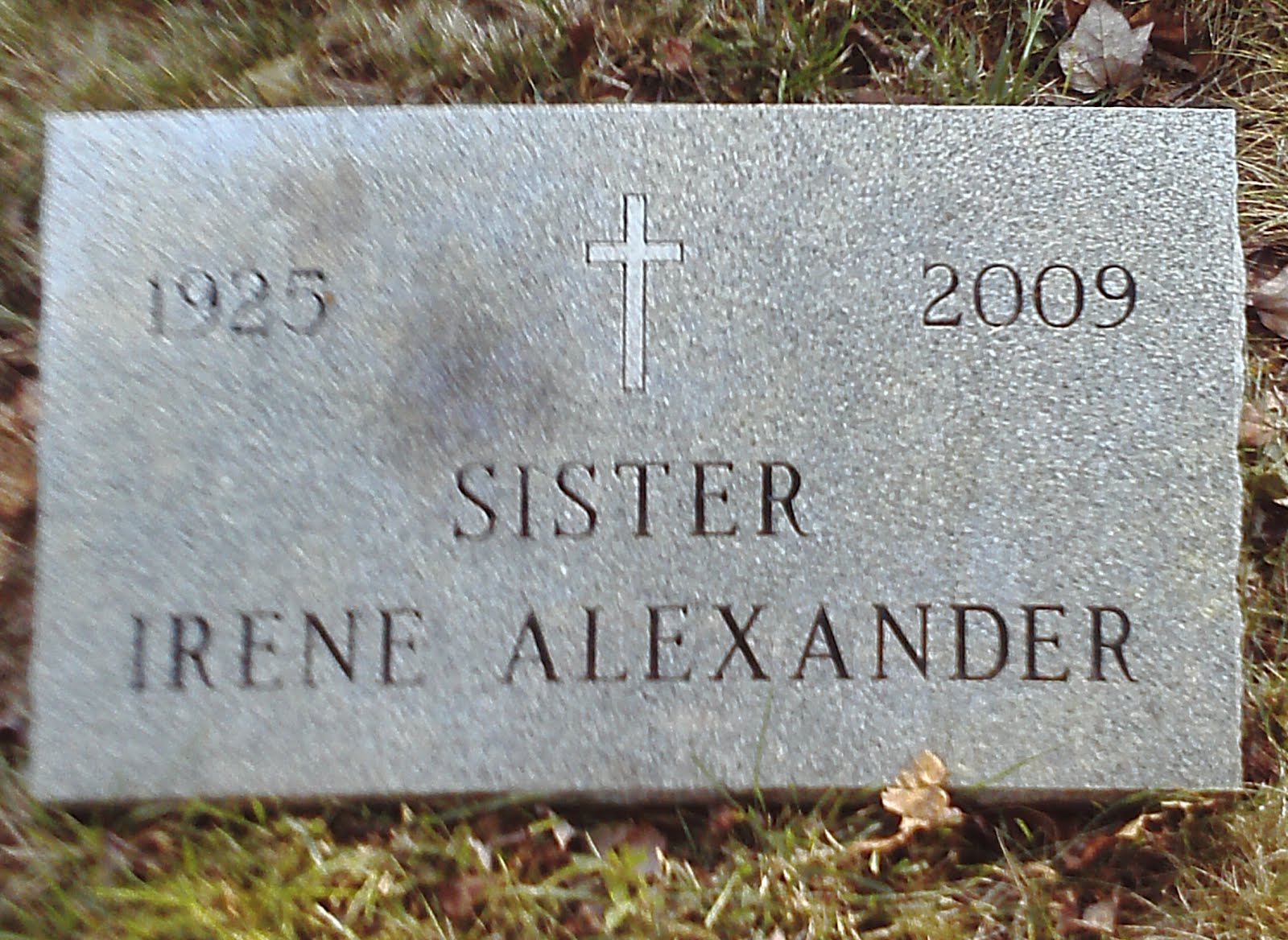
Here are more photos provided by an alumnus. These are of the Linton hall Cemetery, located on the Linton Hall property, north of the pool.
Friday, June 14, 2024
Linton Hall Photos (part 2) Linton Hall Cemetery
Here are more photos provided by an alumnus. These are of the Linton hall Cemetery, located on the Linton Hall property, north of the pool.
Tuesday, June 11, 2024
Sister Mary David, former LHMS Principal, Dies
---------
Read more in my two books: Linton Hall Military School Memories: One Cadet's Memoir" and "Linton Hall Military School Memories Volume 2."
The first volume is available only from amazon.com (or for shipments to Mexico, amazon.com.mx) The second volume (either English or Spanish version is available on Amazon as well as barnesandnoble.com and walmart.com in the US. In Mexico, it's available from either amazon.com.mx or lulu.com. Prices to Mexico may be shown in Mexican pesos.-------
Copyright 2024 by Linton Hall Cadet. Please respect copyright by linking to this post instead of copying and pasting. This blog is not affiliated with Linton Hall Military School and all opinions are those of the author. Comments are always welcome; please do not use your name or names of others.
Thursday, September 13, 2018
Sister Mary David, OSB Writes Back
For the past eight years, I've been writing about Linton Hall Military School, which I attended while Sister Mary David was principal. A few years ago, she resumed use of her birth name, and is now known as Sister Doris Nolte, OSB. She is still at the convent in Bristow, where she is involved in projects including adult literacy and training caretakers.
I believe that, as Principal, she was ultimately responsible for both the good and bad aspects of LHMS. Therefore, I wrote her a few days ago, asking for an apology. I wrote:
"Sister Doris Nolte,
I attended Linton Hall while you were principal.
Linton Hall was good academically, as were the field hikes and camping.
However, punishments were cruel and excessive, including ..."
(A long summary of the negative aspects of Linton Hall which I've written about on my blog follows.)
"Now the truth is out, shared and corroborated by many LHMS alumni, thanks to the Internet.
I don't wish for what you did to us to be done to you, since to wish that would take me down to your level.
But I do believe that a sincere, public apology from you to the hundreds of cadets who attended Linton Hall while you were principal is the least you can do, and is long overdue.
If you decide to reply, I will publish your response on the internet for all to see. If there's no reply within fifteen days, I will report that fact, and your silence will speak louder than words.
Sincerely,
A Linton Hall Alumnus
(It doesn't matter who I am. I am one of hundreds who suffered at Linton Hall.)"
Here is her reply:
"I'm very sorry these things happened while you were at Linton Hall. I'm not aware of all the things you spoke of, but I'm sure they were traumatic to some of the cadets. Forgive us all for the unpleasant things you experienced while a student with us. We meant no harm, but we tried, to the best of our ability, to make Linton Hall a safe and caring environment. If you wish to discuss this further feel free to visit me at the monastery here in Bristow.
Peace and blessings,
Sister Doris (formerly Sister Mary David)"
After much reflection, I replied:
"Sister Doris,
Thank you for your prompt reply.
Although I would not characterize LHMS as "caring," I accept your apology and forgive you. I wish you well.
I can speak only for myself, and will share your reply with other alumni."
I have not asked for permission to share her email address, but if you'd like to write to Sister Doris Nolte, OSB, the address of the Benedictine Sisters of Virginia is the same as for Linton Hall School, and can be found on the web.
Alumni comments are welcome. My Facebook page is visible only to LHMS alumni who've friended me, whereas the blog can be seen by all. You may wish to comment in both places.
---------
Read more in my two books: Linton Hall Military School Memories: One Cadet's Memoir" and "Linton Hall Military School Memories Volume 2."
The first volume is available only from amazon.com (or for shipments to Mexico, amazon.com.mx) The second volume (either English or Spanish version is available on Amazon as well as barnesandnoble.com and walmart.com in the US. In Mexico, it's available from either amazon.com.mx or lulu.com. Prices to Mexico may be shown in Mexican pesos. -----Copyright 2018 by "Linton Hall Cadet."
Please respect copyright by linking to this post instead of copying and pasting.
This blog is not affiliated with Linton Hall Military School and all opinions are those of the author.
Comments are always welcome; please do not use your name or names of others.
Monday, July 23, 2018
Maxime "Max" DuCharme, Commandant of Linton Hall Military School, Passes Away
In 1946, he graduated from Belmont Abbey, a high school founded by Benedictine monks (and later a four-year college) in Belmont, N.C.. Belmont Abbey's 1946 yearbook, the Spire, below his name bears the quote "The cynosure of neighboring eyes," a quote from John Milton's 1645 L'Allegro. He is described in the yearbook as "A happy-go-lucky fellow, handsome, plays football, and loves a good bull session. His effervescent friendliness and his gentlemanly manner [have] won many friends for him during his past four years at the Abbey. He is a cadet Lieutenant."
At age 18, after graduating from high school, he enlisted in the U.S. Marines, and trained at Parris Island, S.C. and Camp LeJeune, N.C.. As a Marine, he was sent to Trinidad, Cuba, Puerto Rico, and various European countries, and later participated in the 1950 landing in Inchon, Korea. He was later Operations Chief of the Engineering section of the Equipment branch, and did a tour of duty on the Japanese island of Okinawa. He married and had a son, then in 1959 became a Marine recruiter in Traverse City, Michigan. He retired from the USMC with the rank of Master Sargeant. A proficient marksman, he was awarded at least two NRA medals.
In 1965 he became Linton Hall's fourth and final Commandant. After the school dropped the military program, he continued at Linton Hall, teaching "Outdoor Education, Conservation and Ecology" (OECW) which apparently is quite similar to the field hikes of LHMS.
His wife, Agnes Louise, passed away in 2011 at age 80.
-----
Source: Bozeman Daily Chronicle and various other sources.
-----
---------
Read more in my two books: Linton Hall Military School Memories: One Cadet's Memoir" and "Linton Hall Military School Memories Volume 2."
The first volume is available only from amazon.com (or for shipments to Mexico, amazon.com.mx) The second volume (either English or Spanish version is available on Amazon as well as barnesandnoble.com and walmart.com in the US. In Mexico, it's available from either amazon.com.mx or lulu.com. Prices to Mexico may be shown in Mexican pesos.Copyright 2018 by "Linton Hall Cadet."
Please respect copyright by linking to this post instead of copying and pasting.
This blog is not affiliated with Linton Hall Military School and all opinions are those of the author.
Comments are always welcome; please do not use your name or names of others.
Wednesday, January 10, 2018
Linton Hall Military School Uniform Pictures
---------
Read more in my two books: Linton Hall Military School Memories: One Cadet's Memoir" and "Linton Hall Military School Memories Volume 2."
The first volume is available only from amazon.com (or for shipments to Mexico, amazon.com.mx) The second volume (either English or Spanish version is available on Amazon as well as barnesandnoble.com and walmart.com in the US. In Mexico, it's available from either amazon.com.mx or lulu.com. Prices to Mexico may be shown in Mexican pesos.Monday, January 23, 2017
Linton Hall's Benedictine Tradition: The Shocking Truth
"Benedictine" refers to Benedict of Nursia (480-547) who founded a dozen monasteries near Rome. He was proclaimed a saint in 1220 and the Order of St. Benedict was named after him.
Just what were Benedict's beliefs, precepts and values? They are found in the Rule of St. Benedict, which he wrote to govern behavior in the monasteries he founded. Although the original was destroyed by fire in 896, various (handwritten) copies remain, the most reliable the one kept in St. Gallen, Switzerland.
Benedict saw obedience as a master virtue, and advocated the annihilation of self will. That's right, human beings who are given free will by God should instead obey a "superior" (Benedict, for example.) Alumni of Linton Hall Military School should not be surprised at this.
To justify his Rule, Benedict selectively quotes the Bible. This reminds meme of a quote in Shakespeare's "The Merchant of Venice"-- "The Devil can cite Scripture for his purpose."
In Chapter 2 of his Rule, Benedict states "the proud, the disobedient and the hard-hearted should be punished with whips, even at the first signs of sin." To justify this, he cites "The fool is not corrected by words" (Proverbs 29:19) and "strike your son with rod and you shall deliver his soul from death" (Proverbs 23:14.) Needless to say, he does not explain what makes Benedict, or any abbot for that matter, qualified to whip others.
Chapter 4 contains a long list of "instruments of good works," or rules, the first seven of which rephrase seven of the ten Commandments. Not content to quote God's words, Benedict must have thought he could do a better job restating them. Some of the gems written by Benedict include #11, "chastise the body," #12, "not love pleasure," #59, "despise one's own will" (presumably this does not apply to Benedict, since he believes his will should be followed by the monks, for #59 states "obey the abbot's commands in all things.)
In Chapter 5 he repeats this, stating "obey any command of a superior as if it were a command of God." This ties in with my blog post of February 17, 2011, "Blind Obedience at Linton Hall." I should point out that in the officer commission I received at Linton Hall Military School, lower-ranking cadets were required to follow only lawful commands. This limit on authority came up as well in conjuction with both the Nuremberg trials and the My Lai Massacre trial.
Benedict further states that "God will not be pleased by the monk who obeys grudgingly" (as you can see, Benedict has appointed himself as God's spokesman) and attempts to justify this statement by quoting 2 Corinthians 9:7 which states that "God loves a cheerful giver" and which clearly refers to something entirely different than Benedict's position. In fact, 2 Corinthians 9:7 states, in its entirety, "Each of you should give what you have decided in your heart to give, not reluctantly or under compulsion, for God loves a cheerful giver."
Chapters 24, 25 and 26 advocate shunning as punishment, and the same shunning to anyone who should speak or meet with someone who is the subject of shunning.
If shunning is not enough, Chapter 28 advocates punishment by whipping, and Chapter 30 advocates enforced fasting or flogging of youths.
Chapter 33 speaks of the "vice of private ownership" and states that no one should give, receive or keep anything, not even a book, tablet or pen, and that "all things are to be common to every one," using as justification for his position the fact that the Apostles shared things. Quite a stretch between voluntary sharing and involuntary abolition of private property, it seems. He adds that "monks have neither free will nor free body." Can you get more autocratic than that? And can you get farther away from 2 Corinthians 9:7 cited above, which refers to voluntary giving and goes against both compulsion and against Benedict's contention that monks have no free will.
Benedict wasn't much of a fan of personal hygiene. In Chapter 36 he states that "The sick should be permitted baths as often as necessary but the healthy and especially all young are to bathe rarely." Well, I do suppose that bathing rarely does make a vow of chastity easy to follow!
Though according to Benedict "monks have neither free will nor free body" (in Chaper 33, quoted above) Benedict says that "if one makes a mistake in chanting a psalm ... he must immediately humble himself publicly ... children should be whipped for these mistakes." (Chapter 45.)
Chapter 54 forbids the giving or sending of letters or parcels even to or from one's parents without the abbott's permission, and if any parcels are received the abbott may give them to whomever he decides. Linton Hall Military School alumni will certainly recall the censorship of outgoing (and, less frequently) incoming letters, even between cadets and their parents.
Chapter 69 advocates punishment for those who seek to defend or protect another. In other words, the virtue of compassion is a punishable offense.
In chapter 63, Benedict states that the "abbot, however, since he takes the place of Christ, shall be called Abbot or My Lord."
I believe that Benedict was quite unlike Jesus Christ (Jesus offered mercy and forgiveness) and Benedict was autocratic, self-righteous and arrogant, and does not deserve to be called a saint.
P.S.: This would have made for an interesting book report for Religion class when I attended Linton Hall, don't you think?
-----
Source:
Benedict of Nursia, The Rule of Saint Benedict, translated by Anthony C. Meisel and M. L. del Mastro. New York: Image Books / Doubleday, 1975.
-----
---------
Read more in my two books: Linton Hall Military School Memories: One Cadet's Memoir" and "Linton Hall Military School Memories Volume 2."
The first volume is available only from amazon.com (or for shipments to Mexico, amazon.com.mx) The second volume (either English or Spanish version is available on Amazon as well as barnesandnoble.com and walmart.com in the US. In Mexico, it's available from either amazon.com.mx or lulu.com. Prices to Mexico may be shown in Mexican pesos. -------Copyright 2017 by "Linton Hall Cadet."
Please respect copyright by linking to this post instead of copying and pasting.
This blog is not affiliated with Linton Hall Military School and all opinions are those of the author.
Comments are always welcome; please do not use your name or names of others.
Wednesday, September 28, 2016
Bill Farquhar on Linton Hall History
Bill Farquhar, who was sports coach as well as gym and geography instructor at Linton Hall for several decades, was also somewhat of a history buff. In 1992, he delivered a speech on Linton Hall history. Among the interesting facts he shared:
* Route 619, part of which is also known as Linton Hall Road, was an Indian/Native American trail during the pre-Colonial period. There was also a Native American campground in the portion of the Linton Hall property where Broad Run curves, and arrowheads have been found there.
* There were slaves on John Linton's land, prior to its being donated to the Benedictines for the site of today's Linton Hall School. At least eight slaves are buried there, each grave marked with a large rock. Unfortunately, around 1941-1942, the gardener, who did not know why the rocks were there, and because they made lawn mowing difficult, dug them up and buried them deeper. As a consequence, the location of those grave sites is now unknown.
* During the 1920s, farmers working on the Linton Hall Military School land found cannonballs and old shells from the Civil War. A few of these were put on display in the old convent, and when the new convent was built, Bill Farquhar was given a few. A few years after receiving them, Bill wondered whether some of them might still be live, so he contacted the Sheriff, Ralph Shumake, who called Fort Belvoir. Some soldiers came from Ft. Belvoir and put the shells in a box -- very gently, because they were, in fact, live. They brought back the parts from the exploded shells about a month later.
* During the 1930s, there were very few paved roads in the area. Linton Hall Road was still a dirt road, which became extremely muddy when it rained. This all changed when, in 1938, John Joseph Becker, a lawyer from Norfolk, sent his three sons to Linton Hall Military School. According to Bill, Mr. Becker used his influence with Virginia Highway Commissioner Henry G. Shirley (after whom the Shirley Highway was named) to have the road paved from Chapel Springs to Linton Hall. It was not until around 1952-1953 that the rest of Linton Hall, all the way to Gainesville, was paved.
-------
William Francis Farquhar, "Bill," was born on September 30, 1915 in Washington D.C., and was a Linton Hall Military School alumnus. He began teaching and coaching at Linton Hall in 1940. He served in the U.S. Army during World War II. He was coach and gym teacher, more recently with the title of Athletic Director, for the rest of his life. Bill passed away on January 4, 2011 at the age of 95. His wife, Virginia, predeceased him. Both are buried in the Linton Hall cemetery. The Linton Hall school gym was renamed the William Farquhar Sports Center in his honor.
Special thanks to the alumnus who made me aware of the existence of Bill's speech and to the Prince William County Historical Commission for having audiotaped it.
-------
Read more in my book, "Linton Hall Military School Memories," over 200 pages, 7x10 inches, only $5.69 (or less) at amazon.com
-------
Copyright 2016 by "Linton Hall Cadet."
Please respect copyright by linking to this post instead of copying and pasting.
This blog is not affiliated with Linton Hall Military School and all opinions are those of the author.
Comments are always welcome; please do not use your name or names of others.